Wednesday, December 9, 2009

What's Really In Fort Knox?

The Trading with the Enemy Act, enacted in 1917, gave the President the power by law to oversee or restrict any and all trade between the U.S. and her enemies in times of war. Franklin D. Roosevelt amended the act to extend its scope to the hoarding of all gold. As part of the New Deal, Congress approved legislative changes which removed gold from circulation as money. Private ownership of gold in the U.S. became illegal on April 5, 1933 with the passage of Executive Order 6102.

An exception was made allowing each individual to retain five troy ounces, or $100.00. Rare and unusual numismatic gold coins - having recognized special value to collectors - were exempted. But millions of gold pieces - $20 St. Gauden's and Liberty Head double eagles, $10 eagles, $5 half-eagles, and $2.50 half eagles, that had either been in circulation or hidden away in safety deposit boxes - funneled into the coffers of the Treasury Department. A facility was needed to house them all.

Thus began construction of The Gold Vault. Completed at a cost of $560,000, the doors were opened to accept bullion in December 1936. Wikipedia states: "the first gold shipments were made from January to July 1937. The majority of the United States gold reserves were gradually shipped to the site, including old bullion and more newly made bars made from melted gold coins. The transfer needed 500 rail cars and was sent by registered mail, protected by the U.S. Postal Inspection Service."

Fort Knox, more correctly named the United States Bullion Depository, is located within the confines of the real Fort Knox, a United States Army post in Kentucky. The 109,000 acre base is located south of Louisville, and sports a population of over 23,000 soldiers, family members and civilians. The U.S. Army Armor Center is based there, as well as the U.S. Army Armor School. Training - for both the Army and Marine Corps - is conducted there for crews on the M1 Abrams battle tank. Well guarded, wouldn't you say?

Doesn't Fort Knox evoke memories of Goldfinger, Ian Fleming's 1959 novel? In which Auric Goldfinger - planning Operation Grand Slam - is intent upon heisting the gold contained in that vault? James Bond thwarts this attempt. If you didn't read the novel you've seen the 1964 film. Gert Fröbe is "The Man With The Midas Touch" and Sean Connery his 007 nemesis. In that version, it's up to Bond to foil a plan by the villain to force open the 22 ton blast-proof doors and detonate a device that would irradiate the reserves.

If you really want to watch things blow up, we should write our Senators and implore them to support senate bill S604, Representative Ron Paul's "audit the Fed" manifesto. The companion bill - HR 1207 - already passed the House of Representatives Financial Services Committee. Can you imagine the explosion - of disbelief, consternation, and vengeful litigation that would ensue - if ever such a bill passed permitting inspection of the contents of Fort Knox, and we discovered that the vault was empty?

What would happen if a bipartisan regulatory committee were allowed to physically canvass the premises scouting for the 4,603 tons - 147.4 million troy ounces - that the U.S. Department of the Treasury claims is stockpiled there? If such an inspection revealed there were gold, but not in the specified amount? If an assay determined that the reserves safeguarded there were not what they appeared to be? That the cache of bullion bars deposited their were suspect in their purity?

China Tungsten Online, http://www.tungsten-alloy.com/en/alloy11.htm headlines Tungsten Alloy for Gold Substitution: "its density of 19.25g/cm3 is just about the same density as gold (19.3g/cm3), which bears the similar specific gravity. These advantages make tungsten... the best substitute for the costly metal of gold or platinum... a coin with a tungsten center and gold all around it could not be detected as counterfeit by density measurement alone. We are well accustomed to exploit more innovative applications of tungsten products. Gold-plated tungsten is one of our main products."

Could there be any truth to the talk of 400oz gold-plated tungsten bars seemingly proliferating in bullion depository vaults? Rob Kirby states that just such a thing could well be the case. He has been making some specious statements, but tempers their strength several times by the use of modifiers. In "Doing God's Work," his recent column of November 12, 2009 details in greater length http://www.financialsense.com/fsu/editorials/kirby/2009/1112.html the statements that follow.

Quote: "reports of 400 oz. 'good delivery' bricks of gold found gutted and filled with tungsten within the confines of LBMA approved vaults in Hong Kong... the amount of 'salted tungsten' gold bars in question was allegedly between 5,600 and 5,700 – 400 oz – good delivery bars.
This was apparently all highly orchestrated by an extremely well financed criminal operation. Within mere hours of this scam being identified – Chinese officials had many of the perpetrators in custody." He goes on to say: "And here’s what the Chinese allegedly uncovered."

"Roughly 15 years ago – during the Clinton Administration (think Robert Rubin, Sir Alan Greenspan and Lawrence Summers) – between 1.3 and 1.5 million 400 oz tungsten blanks were allegedly manufactured by a very high-end, sophisticated refiner in the USA (more than 16 thousand metric tonnes). Subsequently, 640,000 of these tungsten blanks received their gold plating and WERE shipped to Ft. Knox and remain there to this day."

"I know folks who have copies of the original shipping docs with dates and exact weights of 'tungsten' bars shipped to Ft. Knox. The balance of this 1.3 million – 1.5 million 400 oz tungsten cache was also plated and then allegedly 'sold' into the international market. Apparently, the global market is literally 'stuffed full of 400 oz salted bars.' ” And in a followup comment, relating to a story which first surfaced in 2004 he states:

"In light of what has occurred – regarding the Gold ETF, GLD – after reviewing their prospectus yet again, it becomes pretty clear that GLD was established to purposefully deflect investment dollars away from legitimate gold pursuits and to create a stealth, cesspool/catch-all, slush-fund and a likely destination for many of these 'salted tungsten bars' where they would never see the light of day – hidden behind... legalese 'shield' from the law." End quotes.

Trace Mayer sent me this link "Why Gold Bugs Are Nuts," written by Alex Stanczyk. http://www.rapidtrends.com/2009/11/14/why-gold-bugs-are-considered-nuts/ Stanczyk pens the ‘Rapid Trends Insider’ newsletter. He writes from the perspective of one who has been thoroughly vetted in all things bullion. Stanczyk, without identifying the author or resorting to an ad hominem attact, points out the weaknesses in Kirby's allegations. "This story is tainted," my words, not Stanczyk's, "taint nothing but bullion crap."

He writes that unsubstantiated Intranet rumors has set gold bugs to running around screaming "the sky is falling." On that premise, I would assume that Stanczyk feels such a tale to be fantastical. He contends the author's allegations are unfounded if proof cannot be produced corroborating such claims. "Reports?" Alex says,"reports by whom? These conclusions are based on what? Where is the evidence?" Like Clara Peller - of 1984 commercial fame - stated, "where's the beef?"

If there really are such faux bars taking up floor space in vaults around the world, there are tests that could determine their verity, without them being fubar. Tests to ascertain authenticity include actually drilling the core and assaying the sample or, less obstrusively, to non-invasively determine actual lattice structure of the metal electromagnetically. And why would these fakes have been substituted in the first place? A criminal undertaking of unprecedented scope? Or something even more nefarious?

Were these bullion bars - if now vanished - part of a sinister scheme to suppress gold prices? Chris Powell of GATA explains: "While central banks traditionally have said they lease gold to earn a little money on a supposedly dead asset, in 1998 Federal Reserve Chairman Alan Greenspan told Congress that this was not true. Central banks lease gold, Greenspan admitted, to suppress its price." http://www.federalreserve.gov/boarddocs/testimony/1998/19980724.htm

So many questions, so many lies. Our only hope to discovering the truth may rely upon the passage of Representative Paul's bill - backed by thirty Senate co-sponsors - being approved by Congress. Even then, it would be subject to Presidential veto. When it comes to the subject of gold and Presidents, the Oval Office doesn't display the best track record. So then, have we come full circle? Central banks leasing gold into the market, to suppress the price? Isn't that trading with the enemy?

Buy Silver. Buy Gold. Save Copper. Start Now.

Don't Travel To Europe

When planning a vacation, there are all sorts of questions one must ask. Where would I like to go? How long do I want to stay there? Where will I stay? What will I do while I'm there? How do I plan my itinerary? Which airline is most reliable? How will I get about once there? Will I travel by taxi, bus, or walk? Will I be able to deal with any language barriers? Will anyone there speak English? Do I need to learn the basics of a foreign language first? How do I ensure I get the best prices?

The questions could go on and on which is why, I suppose, that some travelers opt for a tour package. The advantage of such a promotion is that all the worry of the aforementioned anxiety-producing questions has already been addressed, leaving you free of stress and better able to enjoy your trip. All you have to do is save your pennies and then fork over a humongous check, or put a ding in your credit card that the best auto body and fender shop would be hard pressed to repair.

The disadvantages of a tour package? Well, ten countries in eighteen days - like the one I went on - can quickly become a blur. You rapidly reach the point of saturation; sensory stimulation overload. Your computer simply doesn't have a large enough gigabyte hard drive to store and replay all of your pleasant memories. Best take a video camcorder or a good digital camera with you and prepare to use it constantly. Otherwise, you will forget a lot of your encounters.

Tours are preplanned so that groups can experience some of the highlights of each area, that the tour company owners feels vacationers would like to experience. Or are they? Did it ever occur to you that tour promoters are out to make money? And that the planned daytrips include junkets to destinations that merely allow them to make the greatest margins after negotiating "group-discounted" admission prices? This is evident in lodging, if you've ever spent a night in decrepit environs.

There's never enough time to properly enjoy one locale before you're whisked to the next. At the Eiffel Tower - after strenuous climbing - we reached the second platform. Try standing atop a thirty-seven story tall building. That's the height of this level, and it provides a spectacular panoramic vista of Paris. By then, only eight minutes remained of our alloted visitation time. We had to cram into an elevator then rush two hundred yards to the bus. By that time both Hanni the tour guide, and Marco the driver , were visibly upset, one clucking in German, the other muttering in Italian.

You can't say you've visited Paris unless you've attended the Louvre. It is filled with marvels. Paintings. Leonardo's Mona Lisa. Sculptures. Venus de Milo, and Nike of Samothrace. Our tour guide - just before leaving us to wonder, on our own - explained that to properly experience all that the Louvre has to offer, one would need to expend four and a half months. We had three hours and forty-five minutes. By now, you might be wondering yourself, "aren't these columns supposed to be about precious metals?" "Aren't we travelling a long ways to get there?"

I apologize for the side trip, but some of the same questions that arise regarding travel are pertinent to the buyer considering the purchase of foreign gold coins. First of all, why would anyone want to purchase gold, let alone foreign gold coins? In the United States, and worldwide, our respective governments are expanding the monetary base of all fiat currencies. While this debasement is a global phenomena, it is most egregious in America, leading to dollar depreciation that is rapidly eroding our purchasing power.

Tangible gold - and to a lesser degree, silver - held in one's own possession, have long been according the status of a safe haven. They provide sanctuary to the forlorn - fleeing foundering fiat - festering from foolish failing fiscal policies. Our once-great nation is about to become a banana republic, and it won't be because we will be planting acres of Musa sapientum in our southern states as global warming encroaches. It will be courtesy of approaching hyperinflation.

That said, why would anyone want to purchase foreign gold coins? For the same reason one might want to travel there. Curiosity. The mystique of exotic locales. The desire to experience something exraordinary. The reasons vary, but - just as one might be wary of a leprous peasant child purporting to be a docent guide - you need to be careful that you are not purchasing overpriced coins of purported numismatic value masquerading as nonconfiscateable gold bullion.

Unscrupulous dealers will sometimes import foreign gold coins and market them in this country, not because they offer compelling value to buyers, but because they can purchase them cheaply and then mark them up for greater profits. There is no such thing as any type of gold coin - not subject to confiscation - if government criminals decide they want to repeat the Roosevelt Grand Theft of 1933. They make the rules, we're just the fools. But, if that happened, it might be wise to keep a few hidden. Just for safekeeping.

One problem with foreign coins is that they don't come in easy-to-recognize fractional ounces as do more common bullion coins. If your buyer is a coin dealer - or an avid collector on ebay - you'll be fine. But, otherwise your resale market for coins with bullion content like .1867, .2304, or .2354 ounce could be limited. These coins do have a robust resale market, and premiums are paid for such gold coins, but that demand exists in their own countries, not here Stateside.

If you wish to purchase foreign gold coins, do it only to augment a foundation of several ounces of familiar American Eagles. Then, if you still want to tour the golden globe, there are several countries that produce gold bullion in an internationally recognized form, the one troy ounce round. Stick with any bullion product from Canada, South Africa, Australia, Austria, or China. You should be fine. See the sites of these nations. Just stay away from sidestreets and alleys. Otherwise the little guys could pick your pockets.


Buy Silver. Buy Gold. Save Copper. Start Now.

Sunday, December 6, 2009

Buying Junk On Ebay

In recent columns I have covered the issue of "getting your money's worth" when buying bullion. Recent price increases in precious metals valuations has increasingly focused public attention on silver and gold. Long viewed as a safe haven, holding these commodities is touted as a means of preserving your purchasing power as the dollar loses its status as the World's reserve currency. The dollar is depreciating fast and - like an impatient parent pushing a recalcitrant child off the end of a diving platform - its about to go over the edge and plummet.

One should always strive to get the most for their money when acquiring bullion. Regardless of the source, you want to drive a hard bargain and get the best deal you can. Right? One of the least expensive means of purchasing bullion - frequently with the lowest mark-ups in the form of premium paid above melt - is to buy old 90% silver content coins. Until 1964, these coins were in circulation, serving as our everyday change for commercial trade and personal transactions. Called junk silver, it is available from most online dealers in varying quantities, by roll or by bag.

As illustrated in another column, it is a given fact that, as silver circulates, wear accumulates on high points on the relief of the design, and along the rim. Some coins, like the early Standing Liberty quarters, were poorly designed. The date wore away too easily, in many cases obliterating the year. It is more common, nowadays, to find dateless Standing Liberty quarters than ones with the year yet legible. Coins that develop wear incrementally lose microscopic amounts of their silver bullion content, and over years the loss can become significant.

Your best bet to get the most for your money then, would be to buy bags of junk silver. As I implied, you can purchase them from any number of online bullion dealers. Or you can do like I've done in the past. Search ebay for silver, then hit U.S. coins, and you'll usually generate about 40,000 hits. You need to be fast, and know what you want ahead of time, and what you're willing to pay. Because if you take this route you'll discover that the listings fly by you, as many as fifty expiring per minute. Sometimes taking this shotgun approach can lead to good deals though.

It's probably better to take a more relaxed approach. Say you'd like to bid on $10 worth of junk silver. You could just type in $10 face silver, and you'll generate several hits. But you'd probably be better off entering silver half dollar rolls ($10) or silver quarter rolls ($10) or silver dime rolls ($5). Depending on whom your bidding against the prices can vary, but will usually reflect a small ten to fifteen percent premium to melt. Halves generally are bid higher. Don't forget to factor in shipping costs. And always check feedback for a high number with nearly 100% approval ratings.

My recommendation if you're just starting to accumulate junk silver as bullion is to pick up 1964 90% silver content Kennedy half dollars, as well as 1965 to 1969 40% silver content Kennedy halves. The 40% halves reflect the lowest downside risk, you can always spend them for their face value. But coinflation.com reveals their silver content is currently valued at nearly $2.73. The 90% are valued at $6.67. A bid at melt for $10 face would need to be $133.40. You can use advanced search features and check completed auctions for similar items to determine a fair bid.

One trick I employ is to bid on multiple listings from the same seller. They will often discount shipping and handling charges a considerable amount. You might want to underbid a bit to see if you can get the shipping essentially for free. If at first you don't succeed, don't become disheartened. There are people and sniping services that do this professionally. Just keep bidding and eventually you could win a listing. Don't make the mistake of chasing a competitor's bid if it exceeds your predetermined ceiling. There will always be another item similar to the big fish that just got away.

My second choices for junk silver would be a tie between 90% silver content pre-1964 Washington quarters and 90% silver content pre-1964 Roosevelt dimes. If the day ever comes when coins are valuable and currency worthless ("hey, that's now!") it will be useful to have all denominations for different levels of bartering. Washington quarters have been minted since 1932, you might get some earlier ones that are pretty heavily worn, with features obscured. In the parlance of coin collectors and bullion buyers these are known as "slicks."

Roosevelt dimes, in contrast, have been in circulation a far shorter period of time. Their production by the United States Mint began in 1946. They will show proportionately less wear than older dimes. Collectors are often drawn to the design of a coin, and are thus willing to pay a premium based on their desire to acquire them. This seems to be the case for the "Mercury" dime, actually originally referred to as the Winged Liberty Head design, the Walking Liberty half dollar, and the Standing Liberty quarter. If you bid on these, you'll be competing with numismatists.

I have to admit, Mercury dimes are "pert little thangs." Designed by Adolf Weinman in 1915 the former student of Augustus St. Gauden's was widely renowned as one of the nation’s best sculptors. Production of Winged Liberty Head began in 1916 and continued through 1945. This same artist designed one of the most elegant of American coins, the Walking Liberty half dollar. This coin circulated from 1916 to 1947. Herman MacNeil designed the Standing Liberty quarter. It circulated from 1916 to 1931, but its life was cut short by plans for a quarter honoring the bicentennial anniversary of George Washington's birth.

All of these coins are 90% silver bullion content, but if your goal is to get the most bullion you can afford, stay away from these puppies. While the first litter I mentioned might bump your leg and lick you affectionately, these little rascals will nip your ankles. And they have sharp teeth. The premium you'll have to pay for these coins is just too high for them to qualify as good deals for bullion. You could still place your regular bid amounts and you might get lucky. Who knows? Stranger things have happened. The revenants who haunt these roams have to sleep too, so you might have a ghost of a chance.

Finally, there's the Barber series. These coins will likely be worn smooth, even if you were to win them at a fair price. If you closely examine images depicting the coins you are bidding upon, you'll note perhaps one or two coins that might grade fair, many will be good, but most will be about good. This is not good. The features of the designs on these coins are barely visible, the date may only be visible if you turn the coins at an angle and squint, and these coins are often discolored, bent, scratched, holed, or otherwise basically obliterated. You'd be doing them a favor to bury them.

There is far too much to cover in one column to touch upon all the basics in bidding on ebay for silver bullion, but I hope I've covered the essentials. You may find it worth your time to enlist the support of a sniping service. This will free you from having to watch your auction as the clock ticks down, waiting for the last seconds to place your bid, then cursing if you're too late or if you became distracted and missed your chance. Sniping services take over this role for you. The one I use is PowerSnipe: http://powersnipe.com/. See you on ebay, where they never run out of bullion.


Buy Silver. Buy Gold. Save Copper. Start Now.

Caveat Emptor Aurum

In some other recent colums, Sifting Silver, and Heavy Metal, I have been alluding to how important it is to employ an accurate system of weights and measures to ensure you get your money's worth when you buy bullion. I pointed out that precious metals are quoted with spot prices stated in troy ounces, but in America we're accustomed to using the Avordupois ounce. Troy ounces are heavier at 31.1 grams, than a corresponding Avordupois ounce at 28.35 grams.

As a result we are, at times, unwittingly paying a hidden premium to purchase coins based on this confusing duality. This can be averted if you are purchasing items minted in the same system (ie. paying troy price for troy ounce coins). For example, there is no problem - if buying American Eagles, either silver, gold, or platinum produced by the United States Mint - as they are all true one troy ounce .999 fine examples of pure bullion coins. However, their own website does not clarify the issue. Maybe they assume everyone knows precious metals are troy ounces.

Herewith, the exact wording from their own site, which may be confirmed by the link I provide. "Like its proof counterpart, the American Eagle Silver Uncirculated Coin is available in a one-ounce size, while the American Eagle Uncirculated Coins in both gold and platinum are available in one-tenth, one-quarter, one-half and one ounce sizes, as well as a complete four-coin set containing one coin of each size. The American Eagle Platinum Uncirculated Coins carry the same reverse design as the American Eagle Platinum Proof Coins."

http://www.usmint.gov/mint_programs/index.cfm?flash=yes&action=american_eagles This lack of precision could confuse a public not versed in precious metals. How many beginners would even think to question that the ounces might be different? What about investors who want to buy pre-1933 American gold coins? Those coins - partly as a result of numismatic demand - sell at a premium to spot. The current price of an "almost uncirculated or better" $20 Double Eagle St. Gauden's piece listed at APMEX is $1536.79. This with melt at $1153.50.

So there's already a 33.23% premium built into the price. Now, granted, few educated investors are going to be bidding - on the St. Gauden's series minted from 1907 to 1933 - for their gold bullion content. Nor will they bid upon the the Liberty Head Double Eagle series that preceded them, minted from 1850 to 1907. Few educated investors, I'm trying to imply. But greenhorns are entering the market. And all they've heard is that gold is going up. "Buy gold before it's too late."

There is a horde of these new buyers - fearing the dollar's demise - beginning to flood into the market, seeking bullion as a safe haven to guard against loss of their purchasing power. When - as is occasionally the case - demand exceeds supply, the Mint ceases to distribute Eagles in any form. This happened in August of 2008: http://www.gata.org/node/6489 and again this year around Thanksgiving: http://news.coinupdate.com/us-mint-suspends-sales-of-gold-and-silver-eagle-coins-0053/.

Most online dealers offer an array of gold and silver one troy ounce coins from other countries; for example the Canadian Maple Leaf, the South African Kruggerand, the Austrian Philharmonic, the Chinese Panda, or the Australian Kangaroo Nugget. There is also a Mexican gold piece - the 50 pesos Centanario - which is 1.2057 troy ounces. Large dealers also carry items such as the Austrian 100 Corona piece, or the Hungarian 100 Korona coin, both of which contain 0.9802 troy ounce of gold. The market for these two coins is limited compared to the others.

When supply dries up, buyers may turn to available bullion regardless of source. Online dealers are probably your safest bet to purchase one troy ounce 22 karat gold American Eagles, or their counterpart one troy ounce 24 karat gold American Buffaloes. If they're sold, out you might turn instead to one troy ounce foreign bullion gold coins. If even these are gone, you could consider fractionals. 1/20, 1/10, 1/4, or 1/2 troy ounce bullion will come in handy if gold ever functions as money again. However, the premiums you'll pay increase the smaller the size of the fractional.

At times of highest demand, even these bullion coins may be difficult to obtain. It will seem like you can't find gold anywhere. Dealers will request payment in full, but promise only to fill your order when coins come available, with waiting periods that could approach four months. For this reason - and from a misplaced fear of confiscation - many buyers will turn to pre-1933 gold coins. Not for their collectible value as numismatics, but because it's the only form of gold bullion they can find.

This is not the smartest thing to do. As mentioned earlier a high premium will be charged above the melt value of the bullion content of the gold. The St. Gauden's gold pieces are a bit more in demand than the Liberty Head series, and prices reflect that. At any given price, the St. Gauden's will command a price $15 to $20 above the Liberty Head. Right now Liberties are available at APMEX for $1524.11. How much gold do you get for this price? Less than you imagine. These coins don't contain an ounce of gold, as novices might assume.

Both Liberties and St. Gauden's gold pieces were minted to identical specifications. They weigh 33.346 grams and are composed of an alloy of 90% gold and 10% copper. This makes them .900 fine gold, in the parlance of the industry. As a result, even though heavier than an ounce, their content is only 0.9675 troy ounce. This ratio holds true for the smaller $10 eagle with 0.4837 troy ounce, the $5 half eagle with 0.2418 troy ounce, and the $2.50 quarter eagle with 0.1209 troy ounce of pure gold.

Thus, if you are buying old gold for its bullion content, you're paying dearly for the privilege, in this case another hidden 3.5% tacked on to the existing premium. Your "ounce" of gold, thanks to the vagaries of nomenclature, could cost you much more than you expect. Buy pre-1933 gold coins for their bullion content and you could be paying the equivalent of $1592 for a troy ounce, when melt is only at $1155. Not the smartest move in my book, Albert. Save your money. Wait. Bullion will be back. Buy it on dips and hold on for the ride of your life.


Buy Silver. Buy Gold. Save Copper. Start Now.

Worse For The Wear

Machine parts need lubricant to reduce friction and the effects of wear. Coins are no different. They require protection to protect their surfaces from deterioration due to the constant sliding motion they experience in transfer from one hand to another, or to minimize the abrading action from continuous contact with other coins. If you really wanted your change to last longer, you could get out a bottle of WD-40 and spray a tiny amount on each surface of your coins. Then next time you pull into the drive-thru lane of a greasy food joint, you could give as good as you get.

The idiom "worse for the wear" is one which intimates that somethings is in poor physical condition due to long use. And it's what happens to coins when they become old - they begin to resemble the appearance of a beggar - having experienced a lifetime of handouts. They say too much contact with people can leave you feeling worn out, I expect coins feel much the same way. It's hard for me to envision the hard metallic surface of a coin becoming abraded by the soft cells of human tissue, but it happens.

Rock is harder than water, yet consider the smoothness of stones exposed to rushing water for great lengths of time. You've picked one up and felt how slick the surface was, all the high points worn away. So common sense and experience teach us that items - such as coins - become worn down over the course of time. One way to define "worn down" is to be spent. And being spent can cause a coin to become worn down. Kind of a Catch 22, isn't it? The more useful a coin is, the more useless it becomes?

Why would being worn down apply to bullion? Because we don't want to accumulate bullion in forms that provide us with less than the optimal amount we can afford for our money. Silver and gold coins provide a means of protecting our purchasing power. They have long been thought of as a safe haven in this regard. People are flocking to precious metals like a feathered funnel cloud of starlings settling on overhead high-power electrical transmission lines. They will be shocked by how thin their profit will be, if they don't take care to invest wisely.

In other columns I've suggested that one of the cheapest ways to invest in silver bullion is to pick up bags of 90% silver-content coins that were produced by the United States Mint prior to 1965. Anything 1964 and before. These bags are referred to as "junk" silver, implying that they are circulated and not of collectible quality. They are generally sold in "face" amounts, an example being "$100 face value pre-1964 junk silver bag, buy-it-now $1595 or best offer," a listing the type of which you might encounter on ebay.

But this cheap form of entry into the bullion market could prove dear - more expensive than warranted - if you buy the wrong type of junk silver. Put in the simplest of terms, you want new coins, not old. You need to buy Kennedy halves, Washington quarters, and Roosevelt dimes. Because the older coins demonstrate greater wear, you would be getting less bullion for the same amount of money, if those were the ones you bought. Don't believe me? Weigh them and you'll find out. That's what I did. I did some research, and here's what I learned.

I first googled "coin wear" and found - from the Online Library of Liberty - a copy of an old text that confirmed my suspicions. Entitled Money and the Mechanism of Exchange, it was written by William Stanley Jevons, in 1875. Chapter 13, topic three of his book addresses this issue. How much wear does a silver coin experience while in circulation? His findings are pertinent to present day considerations, and I'm quite curious to see if my results will replicate them.

He states "some attention must be given to the abrasion which coins suffer in use... the loss of metal thus occasioned is of importance and leads to a gradual depreciation of the currency. As coins pass frequently from hand to hand, the amount of metal abraded will be nearly the same as regards each coin of the same type, and each year of circulation. The loss will be proportional to length of wear." In other columns I will explore the gradual attenuation of modern day coins, today I'd like to look at the oldest series you're likely to encounter in junk bags.

The Barber series of halves, quarters, and dimes was designed by Charles E. Barber, sixth Chief Engraver of the United States Mint. Production of the coins began in time for their use to begin in 1892. The dime and the quarter ran through 1916, but the fifty cent piece was curtailed in 1915. Plans were in motion to create a half dollar from a new concept. Renowned sculptor Adolf Weinmann won a design competition and was the inspiration behind the genius of the pattern for the Walking Liberty half dollar that followed the Barber in 1916.

We expect that - if we buy a $100 face bag of junk silver - we'll get the 71 1/2 ounces of silver as advertised. Right? But what would we actually get if - paying no heed to factors of wear - we purchased a bag of Barbers? New coins straight from the mint in BU (brilliant uncirculated) condition are deemed to contain 72.3 ounces of pure silver, if it were extracted via smelting. At present, the practice is to assign a value of 71.5 ounces to bags of circulated coins to account for their loss of weight due to wear. But is this accurate? It may not make much difference now, but when silver goes way up, those tenths of ounces will weigh up.

I put my hands on as many Barbers as I could locate and here are my findings. One would surmise that smaller denominations would have the greatest wear. Let's see if this holds true. A freshly minted dime of any design will weigh 2.5 grams. I had 126 Barber dimes and divided them thusly. Three were slicks, with no legible date; features were nearly obscured. I chose to subdivide the remainder into pre-1900, into which category eight fell, and post-1900, which accounted for the remaining 115 coins. As expected, the oldest dimes manifested the greatest wear and, accordingly, represent the greatest amount of silver lost.

The dimes that fell into the 1900 to 1916 range of dates weighed an average of 2.2435 grams. Those dimes dated 1892 to 1899 weighed an average of 2.2 grams. The slicks -for which no date can be determined - weighed an average of 2.13 grams. Cumulatively, these dimes demonstrate a wear factor in excess of ten percent. In toto, they average 2.2381 grams apiece. That means the group as a whole had lost 10.48% of their weight to wear, resulting in a diminution of 7.52 ounces from the date of original minting. We're supposed to get 71.5 oz? We got 64.72!

I followed the same methodology with the quarters. A freshly minted quarter of any design will weight 6.25 grams. 43 quarters dated 1892 to 1899 weighed an average of 5.5256 grams apiece. Nine slicks averaged 5.2889 grams. 152 quarters dated 1900 to 1916 weighed an average of 5.6961. Cumulatively, these quarters demonstrate a wear factor of 9.72%. In toto, the 204 quarters average weight is 5.6422, resulting in a loss of 7.03 ounces from the date of their original minting. We're supposed to get 71.5 oz? We got 65.27!

Finally the halves. A freshly minted half of any design will weigh 12.5 grams. There was only one slick in this bunch, it weighed 11.1 grams. 20 halves dated 1892 to 1899, weighed an average of 11.53 grams. 250 halves dated 1900 to 1915 weighed an average of 11.6544 grams. Cumulatively, these halves demonstrate a wear factor of 6.85%. In toto, the 271 halves average weight is 11.6432 grams, resulting in a loss of 4.95 ounces from the date of their original minting. We're supposed to get 71.5oz? We got 67.35!

I think it's fair to assume these coins represent a fairly reliable approximation of what you would find in a junk bag of circulated Barber coins. No two bags will have the precise numbers as mine, but they should be close. The larger the sample you test, the greater the chance of accuracy. So what were the end results? If we had purchased a $100 face bag of junk Barbers, had they been dimes we would have instantly lost $136.63, quarters $128.58, and halves $90.61. This is a considerable amount of money now, just wait til the silver price increases by multiples.

Why pay this premium? It's 11.7% for dimes, 10.77% for quarters, and 7.35% for halves. When coupled with a hidden tax - the fact that you could be buying Avordupois ounces but paying for troy ounce quoted melt prices - you can wind up paying nearly 20% extra for these coins. You'd have to make a 25% return just to break even. If you're a collector, that's one thing. But it just doesn't make good sense to buy these as bullion. You don't want to hear co-workers whispering behind your back "that fool's got more money than common sense" do you?

The Barbers had a dignified design. The various denominations served the nation well during their use as circulating coinage. I'm not disparaging them in any sense, as can be attested to by my column I Need A Good Barber. But despite their beauty, they are not a worthy vehicle to transport you along the road to riches, if what you seek is a safe haven in silver bullion which can preserve your purchasing power while providing the potential to profit. Don't buy Barbers for their 90% silver bullion content because, if you do, you'll feel worse for the wear.


Buy Silver. Buy Gold. Save Copper. Start Now.
Heavy Metal

"So get on your bad motor scooter and ride," wails Keith St. John, preening across the stage, "ah ride ah ride ah ride." The final note hangs in the air - fading - until it disappears. The audience is on their feet, shouting their adulation of Montrose, and their applause is deafening. This has been the longest set yet. Following on the heels of "Rock the Nation" and "Space Station #5," "Bad Motor Scooter" has stirred the crowd to a frenzy. The band pauses, taking a well-deserved break.

We are like diatoms living amidst the inner whorls of a Giant Conch, unaware of the outer world. Around me, it's impossible to hear anything above the noise. We're all hoarse from cheering anyway, so why even attempt conversation? Pulsing colors catch my attention. Laser beams like Jedi lightsabers rend the darkness, overarching serried ranks of tiny butane-fueled waving lights. It's like they're a horde of candle-bearing penitents - an approaching army - intent on worshipping en masse.

I'd like to continue and tell you about the rest of the concert, but I was just using my imagination. We are going to talk about heavy metal today, but not the rock band variety. I could have segued into this piece with an introductory paragraph about Heinrich Schliemann, the notorious archaeologist who discovered the ruins of Troy beneath a tell in Turkey, but that would have been too contrived. So heavy metal it is. Today's column is about knowledge, and an effect of ignorance.

In real estate you hear the mantra "location, location, location." You also hear "America, land of Opportunity." How often do you hear the truth? As in, "there's a sucker born every minute," misatributed to P.T. Barnum. The origin of the phrase provides an interesting footnote itself: http://www.historybuff.com/library/refbarnum.html. Barnum may take half credit - rightfully his due - for the merger of his circus with another to become the Barnum & Bailey Circus, "The Greatest Show On Earth."

Because of a curious quirk relating to where we live, we may be getting short-changed. If you went to the butcher's to buy a cut of meat - and witnessed him sneakily applying pressure to the scale with his fingertips - you would be affronted, likely outraged. You would demand an accurate measurement of the item you wished to purchase, or else you would take your business elsewhere. Why then do we tolerate such shenanigans when we purchase precious metals? Because we don't realize the system is out of balance.

In the United States there is a confusing hodgepodge of three different systems of weights and measures. We are comfortable using the Avoirdupois system of sixteen ounces to the pound. We're all familiar with it, so I need not describe it in great detail. Suffice it to say, it's a system we grew up with and when we hear of an item that weighs an ounce, we instinctively think of our own Avoirdupois ounce - the equivalent of 437.5 grains, or 28.35 grams - as what is being referred to. There used to be another system of weights and measures as well.

The Apothecary System was used in medicine and pharmacy in the United States until 1971, at which time we converted to the metric system. Apothecary is actually medieval nomenclature for a medical professional who formulates and dispenses pharmacological substances, a modern-day pharmacist. From Wikipedia we learn "the English version of the system is closely related with the English troy system of weights, the pound and grain being exactly the same in both. It divides a pound into 12 ounces."

Finally, we have the troy system of weights and measures. Thought to have originated in Troyes, France, this system is the one favored for weighing precious metals. Silver and gold spot prices are quoted in troy ounces, not Avordupois. Most people are unaware that there's a difference. Thus buyers can fall victim to the duplicity of unscrupulous vendors who might try and take advantage of this semantic confusion. Sellers might capitalize via an unintentional de facto form of arbitrage to increase their profit margins.

What am I talking about? Well, consider. The spot prices of gold and silver that we're always hearing about from the talking heads on CNBC? The listed real-time market quotes for the metals found on such sites as Kitco and Amark? The cost determinant basis for bullion sales prices at online dealers like APMEX, and BullionDirect? They all quote the spot price in a form of weight we aren't accustomed to thinking in. Precious metals use a troy oz, not Avordupois. Why does this make a difference?

A troy ounce weighs more than an Avordupois - 480 grains or 31.1 grams - to be precise. An Avordupois ounce weighs only 437.5 grains, or 28.35 grams. The prices quoted at these 24/7 websites are stating the values of a metal, that will be artificially high, unless we modify our thought process. For example; not too long ago silver was quoted in troy as being worth $18.50. Isn't that the same in Avordupois? An ounce is an ounce, right?" Unfortunately no. And this is where an opportunity arises for manipulation during a transaction, such as on ebay.

Because an Avordupois ounce is smaller, it would only be worth $16.86. Not $18.50. With a system like this, it could be subject to misabuse if the buyer didn't understand both forms of ounce measurements. Caveat emptor. Luckily, if one deals - in only United States Mint issued American Silver Eagles, or American Gold Eagles - this problem is obviated as both coins are .999% pure one troy ounce of metal. The government has taken the guesswork out of this for us. Hey, they did something right?

The problem arises again when we go to make purchases of coins that are not recognized bullion minted by the United States. Coin of the realm, 90% silver coins that circulated for their use as
money until 1964 are sold based on troy prices. Again, so? Well, Percival, if you buy an item that is worth $16.86, but is priced at $18.50, don't you think there's something wrong with this picture? If we purchase a $100 face bag of circulated junk silver online, no problem. You get what you paid for. But what if you're bidding on ten "ounces" of silver on ebay? What kind of ounces are they?

You might not even question the transaction. I'm not insinuating that the seller could be out to dupe you. But, accidentally or intentionally, this could easily occur. If you were to win on a bid of $185.00 for ten ounces, you'd be thinking "woohoo, I got it at melt!" Did you? What if the seller was referring to Avordupois ounces, as several current ebay ads do? If that's the case, you just bought 283.5 grams of 90% silver. Divide that by 31.1. You bought 9.1158 troy ounces of silver. You overpaid on what should have been a $168.64 bid. So, Rookie, could be you were just had.

Because you purchased an item priced in troy but in reality Avordupois, you unwittingly offered a 9.73% premium to the melt value. We're safe at present, as online bullion vendors trade in troy terms. But what if you attempt to sell in the future? Then it just became much harder to profit from your holdings. What do I mean by this? Let's say that you know $100 face value of junk silver contains 71.5 troy ounces. You see a listing on ebay which specifies 71.5 ounces of silver. You base your bid on troy - $1322.75 - not realizing the guy used a bathroom scale. He may be guileless, or a hustler.

Five years from now you walk into the coin shop - trying to make eye contact with the owner - who is poring over a greysheet. "Excuse me," you stammer, "I'd like to sell some silver bullion." "Sure," the dealer says, "no sweat. What ya got?" "I've got this bag of $100 face value of circulated silver," you offer. "Junk?" says the dealer, "not so sure I need more junk. Just bought a bunch yesterday and I haven't had anyone buying in awhile." He pauses to fix you with a penetrating gaze, as if to read your innermost thoughts.

"With silver at $70 an ounce, everyone and their brother wants to sell," he goes on, "I even had one old lady in here last week trying to peddle antique sterling silver flatware. Do I look like a smelter? I hadda tell her 'nah, can't help you,' the stuff was tarnished." "How much could you give me for it?" you ask. "Well, lessee," he weighs the bag and calculates, "melt's at $70... so that would make it... $4,564." He looks up with a smile, awaiting my response. "But I figured it out before I came in," you quaver, "shouldn't it be worth $5005?" "Ah hell, kid," he looks as if he's sorry for you, "you're thinking in troy."

"This here bag, Son," he pauses,"only weighs 2278 grams. $100 of face silver will weigh closer to 2500 grams. You never counted the face value, did you?" "Well, no," you argue," the ad said if was 71.5 ounces of silver, I just assumed that," your voice tails off as you realize what happened. "You mean, I got ripped off?" "Nah, Son," he replies, "they sold you a little over $91.10 in silver, because they didn't tell you the 71.5 ounces were in Avordupois." He continues,"you thought you were bidding on troy - $100 face - but they didn't tell you that, you assumed.

"Technically, they didn't lie. But they were preying on your ignorance. Pretty good scam while it lasted, but eventually - after a few people learned the hard way - they set out to educate the others. By 2011, ebay made em start listing silver in troy ounces only. You stand there, staring, unable to believe what you're hearing. "If you bought your silver in 2009 or earlier, you aren't alone. This happened to lots of folks," he continues,"for Gawdsakes, why didn't you people learn troy and Avordupois?"

A blush of embarassment blooms like a rose upon your cheeks. "Prices back then were pretty much set by what buyers on ebay were willing to bid. No one understood the difference between troy and Avordupois," you tail off, chagrined. "Well, Hellsfire Son, that ain't my fault is it?" the dealer fires back. "I'm sorry Son, but we did away with that old system back when silver and gold finally took off. Buying it like that added a premium you didn't know about." Unwilling to accept less than you expected, you turn to leave.

As you're walking out, you're struck by a sudden thought and turn back. He's flipping through his wholesaler's coin buying guide again."Yeah," he asks? "Uhhh, my wife's gonna wanna know
why I didn't sell the coins. Can you explain it to me in simple terms, so I can explain it to her?" A look of exasperation crosses his face, but then is gone. In its place seems to be a look of grudging admiration. "C'mere Kid," he says, as you approach the counter. "Look," he says, "you thought you knew the price of what you were paying for, but ya kinda got bamboozled."

"How so?" you answer. "Well, Son, a troy ounce is heavier than one of our ounces: 31.1 grams to 28.3 grams, okay?" He pauses then continues, "everyone knows we deal in Avordupois ounces in this country when we buy and sell stuff, but what they didn't understand was that precious metals melt prices were quoted in a different more expensive system of ounces." He shakes his head sadly, "you paid too much for that silver Son, because you didn't understand the difference in the systems." He seems almost ready to make an admission, then changes his mind. "I wish I could help you out Son, but looks like today you learned an expensive lesson."


Buy Silver. Buy Gold. Save Copper. Start Now.

Sifting Silver

One definition of the term used is defined as timeworn, and that is pertinent to our discussion today. Use of an object causes it to wear down, to become worn - as in diminished - over the course of time. Use of a coin causes the surfaces to wear, losing infinitesmal particals to transfer as it is handled countless times, or abraded by even the most minimal repetitious contacts. Checking the contents of your pocket to determine if you have lost your money may provide an answer, but perhaps not the one your were expecting.

In fact, even just jangling the coins in your pocket could cause you to lose the money you were checking. You'll have change alright, but I'm talking about the kind of change that means deterioration. The simple act of constantly jangling the change in your pocket, or passing those coins from hand to hand, repeated thousands, even millions of times over years, will cause those coins to become timeworn. If these coins were alive, we would refer to their appearance as haggard. They are old and exhausted, and it is time for them to be retired.

I mention these points to raise the issue of our topic today. Remember that pile of junk silver you bought for Y2K? So that you would have coins to barter with when the onset of the new millenia caused all the computers to go fritzie, erasing all financial records? The silver which, on the morning of January 1, 2000 you realized was essentially useless? And that you had paid a premium for? You weren't about to sell it back to the coin shop at a loss, so you decided to hang onto it.

Silver rose from a trough of $4.23 on July 17, 1997 to a peak $7.80 on February 6, 1998. Warren Buffet had bought 129.7 million ounces of silver bullion earlier, during the previous summer for his holding company Berkshire Hathaway. But the investing public didn't catch wind of the transaction until December, and then it was off to the races. Silver climbed more than fifty percent over the next two months before selling off again, nearly as rapidly, to $4.95 an ounce by May 29, 1998.


If you were fortunate, you began accumulating your Y2K silver on dips during 1999, when you could have purchased it - during much of March and April, and parts of May and June - for under $5.10 an ounce. Had you followed the herd of lemmings as silver was hyped as a must have commodity for the dire outcome foreseen, you would have paid as much as $5.70. 1999 was a volatile year, with four distinct spikes demonstrated thoroughout.


But come the new millenia, when it was found that TSHTF had not come to pass, silver proceeded to gradually sell off. Silver had proven to be artificially resuscitated by Buffett's paddles the year before, and now its heartbeat was absent. There was no ventricular fibrillation pattern as displayed in 1999. Silver seemed dead in 2000. It ground sideways the entire year, drifting slowly downwards in asystole. Flatline. It would continue this pattern for 23 months until it hit bottom on November 27, 2001 at $4.07 an ounce.

But then commenced a rally - slowly at first, then gradually gaining momentum - that has seen silver climb five times that height in an ongoing bull market that has not yet reached its climax.
As the price of silver rose, so did the magnitude of its pendulum swings from temporary apex to short-lived nadir. Silver almost touched $21.00 in March 2008 but, within six months had dropped below $9.00 on the heels of the October 2008 global hysteria. It has recovered from that blow and is renewing its energy for another try at the March 2008 highs.


So, having forgotten all about that stash of junk silver, aren't you glad, Roland, that you meant to sell it but never did? Maybe there's some good to procrastination after all? So why has silver been rising again, after years of moving sideways? You can thank Alan Greenspan for that, initially. The former Chairman of the FED, Greenspan was responsible for flooding the economy with easy money following the NASDAQ debacle of 2001. It takes awhile for money to find an asset it wants to ask out, but silver is finally going to the Prom, after real estate decided to stay home.

So now you've decided there's too much money floating around, and before you know it we'll have hyperinflation. You decide to haul out your cache of junk silver and inspect your collection of pre-1965 90% silver coins, perhaps with the intent of adding to it. But wait, what's this? As you pour out your sack of silver, you notice that some of the coins are bent, a few others are blackened as if they had been through a fire. You pick those out and set them aside; they're a bad influence and you don't want the filthy little buggers rubbing off on the bright ones.

You continue to pick through your silver, not really examining dates for numismatic rarities, but just daydreaming and thinking to yourself "what if silver goes up to $30,000 an ounce" like Jason Hommel thinks it could do when his brain is wound up tighter than Jason Statham in Crank? And then you begin to giggle in uncontrollable glee, unable to restrain your mirth as you imagine all your coworkers who mocked your silver purchases in the first place having to eat crow and worship you, in hopes that you'll adopt them and lift them from their hyperinflation-induced state of abject poverty to one of immeasurable wealth, epicurean delights, and carnal contortions certain to cause Caligula covetousness. But I digress.

You're looking at your coins and you notice that some of the older dimes - they look like Mercury's - are really worn down, you can hardly see the date. There's some Standing Liberty quarters that you can't see a date. You test the heft of these, and it sure seems like they're a lot lighter than some of the newer coins. You decide to include the coins that are really worn down so that you can hardly see the features with the ugly bent ones. And while you're at it, you decide to add to the pile any with bad scratches or paint on them.

Congratulations, you've just been initiated into the world of silver sifting. Since I christened this practice, I get to make the rules. Sifting silver is going through your cache of junk and removing anything that is inferior in any fashion. Survival of the fittest. Gresham's Law. Keep the best, forget the rest. The day will come when you want to sell some of your silver or, Heaven forbid, use it for purchases following a catastrophic worldwide economic breakdown. If that comes to pass, use your ugly pile first.

Selling your most worn coins now, can actually have beneficial financial ramifications for you later. At present prices, it won't be noticeable, but if you had a bag of older worn coins - such as Barber dimes, quarters, or halves - that were ten percent lighter than more modern silver coins, the day will come when your resale value will fall by a commensurate ten percent. Right now, junk silver sells for an assumed 715 ounces per $1000 face bag, but trust me, it won't remain that way once silver goes up by multiples. Silver will one day be sold by weight, not by face value.

Build a core holding of precious metals. Try to accrue several $100 face value bags of junk silver, and a few ounces of gold. Keep them close. Never entrust them to a safe deposit box. Banks may be forced to shut their doors just when you need them most. If you decide to take some profits, then sell your ugly pile. When silver subsequently dips, then pick up some newer silver on ebay. It's there. Find it. Buy it. Shampoo, rinse, repeat the process. Get rid of those ugly coins, and the puny ones. Now. Otherwise, when you decide to sell, you could go home a little light in the wallet.

Buy Silver. Buy Gold. Save Copper. Start Now.

Saturday, December 5, 2009

The Miracle Of Multiplicity

Have you ever felt pressed by an impending deadline? Felt harried from overwork? Felt compelled to put in extra hours for which you weren't compensated? We're going to go way off topic of my usual subject matter today. I'm writing this column for a friend, in an effort to see if it could help him market his software product. In a sense, what we'll be discussing is time management, how to most efficiently benefit from labor-saving techniques, and the benefits afforded those who implement their use.

I think we've all experienced those feelings I alluded to in my opening. The worksite is becoming more stressful by the day. Americans - who labor free of mandates dictating a set number of hours - find they are routinely working fifty and sixty hour workweeks. Seventy is becoming the new forty. Including the commute, our workweeks are consuming an ever-increasing percentage of our waking hours. This has to be detrimental to our well-being, to say nothing of our relationships.

At least we could save money on our health club memberships. Why go to the effort of packing your gym bag, driving to the nearby Gold's Gym, or Bally's Family Fitness Center to lift weights, pedal bicycles, or perform pilates? Why torture yourself on the elliptical machine for half an hour to burn less calories than munching on one Butterfinger in a moment of starved self-flagellation could add? "A moment on the lips, a lifetime on the hips." We don't need a treadmill, we merely need to report for work.

America is one gigantic rat race, and we're the vermin. Haven't you ever felt like a caged hamster, forced to run a never-ending chase within a spinning wheel? Like Sisyphus performing an interminable task, we push ourselves ever harder and harder. And why? Because we continue to work harder, we haven't as yet learned how to work smarter. I don't know about you, Mythological Greek Figure, but I've had it. I want to get off the treadmill. Teach me how to work smarter.

In the 1996 movie Multiplicity, Michael Keaton stars in the role of Doug Kinney, a much-too-busy-for-his-own-good construction contractor. His relationships are strained. Burdened by overwork to the point of near collapse, he accepts the offer of a geneticist savant to clone him. At first the strategy of the scheme appeals to him, as he is able to accomplish several things simultaneously. But soon, the ability to be in several places at one time wears thin.

Unbeknownst to Doug, one of his clones climbs into the marital bed and proceeds to conduct connubial chores. This is not what Doug had in mind, in fact it makes him feel as if he's the one being screwed. I don't want to ruin the movie for you by revealing the entire plot, perhaps you'll rent this enjoyable comedy someday. So let's move on. The point of introducing cloning is two-fold. Have you ever needed to delegate responsibility? But felt like "I have to do it myself, that's the only way I can be sure it's done right?"

A wise manager knows he needs to breed confidence in subordinates, and accordingly will delegate tasks they can handle. But it's not always easy to let go the reigns of power. Additionally, you may well have been capable of doing the job more rapidly with a better end result. Perhaps you're in marketing. You can't do it all by yourself. I don't care if you're the most gifted salesman in the world - you could sell kittens to Michael Vick - the problem is your time. Or lack of it. You can only move as much product as your time and exposure to clients permits.

Enter the miracle of multiplicity. Or should I say multilevel marketing? Wikipedia defines MLM as a structure designed to create a marketing and sales force by compensating promoters of company products not only for sales they personally generate, but also for the sales of other promoters they introduce to the company, creating a downline of distributors and a hierarchy of multiple levels of compensation in the form of a pyramid. But you already know the benefits of MLM or you wouldn't be using it.

So how can my company - GreyStar Solutions - help yours? Since you've started up your enterprise, have you noticed a burgeoning amount of paperwork drudgery associated with tracking all your downline sales? Is your bookkeeper starting to look stressed? Does your accountant have tiny beads of perspiration dotting his brow and a half-crazed look of desperation in his eyes? Does your CPA resemble a giant rodent? Will Hollywood soon be soliciting John Travolta to play him in the next by-the-light-of-the-full-moon scare flick "The Return of The Hamsterman?"

If so, our software can help eliminate those problems. With today's technology, if you're not tracking your business in "real time," then you're already behind. Greystar gives you sales data, commissions, genealogies, uplines, downlines, reports, and dashboards all in real time! Our software is widely used by MLM companies in marketing their product lines without the headaches and hair-raising horrors. We also specialize in Search Engine Optimization, Ecommerce, Affiliate Tracking, and FDA Compliance.

We've helped others in your position to achieve greater success. "I would like to offer my highest recommendation for the services provided by Greystar Solutions and Barry Trottier," states Jim Coover, President and CEO of Isagenix International. "We could not have achieved the success we enjoyed were it not for the responsiveness and integrity of Barry and his team." He adds, "You will be well served."

Another testimonial: "I must say I am very happy with your company. You have delivered on everything asked quickly and cheerfully. The support staff that assisted me in building my infrastructure raves about you and they tell me that they are already recommending you to their new clients! Thanks for going above and beyond the call of duty and I look forward to a long relationship," says Ron Touchard, President and CEO, eWorldMedia, Inc.

I could offer more references, but I don't need to. You need to experience for yourself how easy we can make life. The rest is up to you. So take a deep breath and relax. Stop working so hard, and start working smarter instead. We're here to show you how. Call now. Our number is 404-431-1785. Friendly operators will be waiting to assist you during Eastern Standard business hours eight a.m. to five p.m. Or visit us here at our website: http://greystarsolutions.com/


Yours towards enhanced future profits; God Bless!

Barry Trottier

Bringing Change To America

In the last few weeks I've been emphasizing copper as a commodity which will boom, along with silver and gold, in response to the enormous creation of excess liquidity we are now witnessing. The current administration is following a policy of easy money to attempt a cure for symptoms of a debt-bingeing malady. Aside from extending jobless benefits, one of the few measurable results attributable to this practice has been the levitation of an already over-inflated stock market.

I'll admit, this life preserver is keeping a few drowning banks alive for the moment. That will change as the toxic asset rooster comes back to the rapidly-diminishing-in-value hen house to crow. Many banks - now merely sick and injured - will join the endangered species list. The FDIC is out of funds, and when the Bank of Phoenix and First National Bank of Dodo's go under, their will be no entity available to prevent their demise. More financial institution dinosaurs added to the ever-mounting bone pile.

Silver and Gold are already responding to the increased money supply. Such effects of rising prices to the cause - inflation - often lag the surge in liquidity by as much as eighteen months. But they are now making up for lost time. With the exception of occasional sharp retracements, Gold is making nominal highs on a regular basis, and silver is outperforming on a percentage basis. Copper will drink some of the spiked punch as well, and will share in the inebriation.

At this party, the host would like to convince you that saving pre-1982 copper cents is a great idea. Particularly suited to small investors, sorting cents from your change offers the same opportunity that pulling pre-1965 90% silver coins from circulation did forty-four years ago. But some readers are reluctant to embark on such a venture, for a number of reasons. Opponents to change would argue that you have to obtain pennies, sort them, return zincs, and sell the copper in order to profit.

You can't sell the copper, can you? Currently, melting pennies for their 95% copper content is illegal. However, that will change in the future, particularly when parties lobbying for abolishing the cent have their way. Even so, a market for those pennies now exists. Farsighted buyers - visionary investors - recognize the potential of this Gemini Coin; copper is both a commodity and a form of money. Sales of cents from websites such as The Copper Cave and The Portland Mint bear witness to this market.

What if you wanted a quick route to riches, rather than holding this form of hard metal as a means of purchasing-power-preserving wealth? Well, you could brainstorm and come up with some strokes of entrepreneurial genius. If you'd like to implement this suggestion, perhaps adding a finishing touch I hadn't considered, be my guest. This idea is not copyrighted and if someone displays the initiative, creativity, and start up capital required to succeed, then "you go get 'em, Gung Ho Guy!"

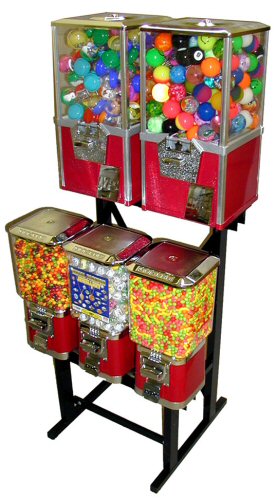
How about if you took your piles of copper cents and began marketing them yourself? How would you do this? How about placing them for sale within vending machines? Remember those gumball machines that used to be ubiquitous? They were everywhere. You seldom see them now, so they're probably available at a discount from some liquidator's warehouse. You could obtain a number of them and negotiate a small share of the profits with sites that would display them.

Inside the glass container you would place plastic capsules with capacity sufficient to contain perhaps fifteen pennies. You could charge a quarter, thus providing a quick nominal 66% return. Of course, you would need to deduct your costs, including the price of the cents. Your margin would not be as great if you were to embellish the pot as I'm about to suggest. How would you entice an adult to purchase these items for a child? Appeal to their gambling instinct. Visually.

For the lowest cost, you could include a mixture of common cents direct from circulation, perhaps ensuring that there were at least fifty percent copper pennies mixed with the post-1982 zincs. In these capsules you could include scrip - like those in Chinese fortune cookies - which explained the composition of the cent, why the Mint changed that alloy when it did, and a short explanation of copper as a commodity, with properties similar to silver and gold in earlier times as circulating money. You could adapt this to teach children about money.

Presenting cents in this fashion, in encapsulated form, would lend emphasis to their worth. When you have to pay for something rather than have it handed to you, you value it more. Pennies would gain panache among the younger set. Parents would be able to introduce thier children to the fun hobby of copper cent coin sorting, and some would become interested in forming their own Lincoln cents collections. Children sharing their hobby at show and tell would gain a certain cachet.

You could color code each paper scrip; inside of clear plastic capsules this would lend each an individualistic air among the spectrum of variety. Children each have their own favorite colors. I could well imaging little Susie ,with her most winsome smile, entreating "No Daddy, I wanted the yellow one, buy me the yellow one," as she gazing imploringly. What father could resist? Even though he'd already spent all his quarters on the first three; he would most assuredly return to the checker for more.

You could have a color code key on the front of each Century of Cents coin dispenser. The code would reveal which particular hue of scrip would contain which era of wheaties, if they were included. This concept would work as well in existing Tractor Time Crane Toy and Candy Vending Machines. You would simply need to introduce your capsules into their enclosures. However, I do feel that there is an unfilled niche in the market for penny vending units that would be best served by a stand alone unit.

Children, and their parents, are human. Which makes them acquisitive. It's in our nature. Color coding the scrip - perhaps by age group with historical footnotes appropriate to various elementary school grade levels - would stimulate the avarice of these budding collectors. They would want the entire set. You need not be worried that sales might wane, as there are certainly many more than one important event to mark the passage of each year. When sales slowed, you could introduce Set 2 of The History of America scrip. The possibilities are mind-boggling.

You could also insert a wheat-backed penny to be included in each group of fifteen common date 1959 to 1981 cents. Lincoln cents minted from 1909 to 1958 are known as wheaties among collectors, and scarce specimens in good condition are prized by numismatists. You could "salt" a small percentage of capsules that would provide a sample of this range of dates. A little research on my part unearthed a large array of more common variety early and later date wheaties that would suffice.

You would first make use of all the wheaties you had discovered by sorting. But if you wished to supplement those cents, for under a dollar - many for less than fifty cents each - the following pennies could be purchased in "average circulated" condition: 1910, 1911, 1912, 1913, 1914, 1916, 1916-D, 1917, 1917-D, 1917-S, 1918, 1918-D, 1918-S, 1919, 1919-D, 1919-S, 1920, 1920-D, 1920-S, 1921, 1923, 1924, 1925, 1925-S, 1926, 1927, 1928, 1928-D, 1928-S, 1929, 1929-D, and 1929-S.

In fact, you'll find that you could obtain the remainder of the series up to 1958 for roughly ten cents - on average - with the only exceptions being the 1931-D, 1932, 1933, and the 1933-D. The letters following the year indicate the United States Mint branch at which they were made. D represents cents produced at Denver, and S represents cents produced at San Francisco. Those lacking a mint mark represent Philadelphia. You could include scarcer pennies, though I would not. You might even include an occasional silver dime to sweeten the pot.

Now let's dwell for a moment and think just how much fun it would be to include a short history lesson with the encapsulated coins? With nearly the entire gamut of years represented since the initiation of the Lincoln Cent into circulation, your field is fertile, limited only by your imagination. For example; 1919: this year is noted as the first to implement the constraints of prohibition - the banning of alcohol consumption - also referred to as The Noble Experiment. 1943: pennies were minted from steel as copper was preserved for shell casings during WWII.

Picture a family - having purchased a Century of Cents capsule from the penny dispenser after shopping - arriving home. Dad sets the groceries on the counter and unbags them. Mom puts out placemats, napkins, and silverware, then begins to prepare dinner. Four year old Johnny walks in and plops into a chair. He places his plastic container atop the table and rolls it around, eyeing the shifting contents covetously. He picks it up and jubilantly shakes the clacking sphere like a master martini mixer.

"Put the pennies down, Dear," Mom smiles affectionately at her son. "We'll look at those after dinner." "Awww, Ma," their little clone grumbles, "do I gotta?" Dad walks over and snatches the pennies away before the cacophony can trigger one of Mom's migraines. Dad surreptitiously sneaks a peek before Johnny has a chance to crack the egg. He is gratified to discover an old cent. The fortune-cookie-like tag reads 1927: Charles Lindbergh flew the Spirit of St. Louis across the Atlantic, the first solo non-stop flight.

Imagine - after dinner - the quality time that could ensue? "Look Son," Dad might say, "here's a 1976 Memorial cent. That's the year I was born." Johnny, entranced, would stare adoringly at his father, thinking "I wanna be just like him when I grow up." It is said that, nowadays, parents - of children aged 6 to 17 - spend only an average of 47 minutes a day talking with them. So why not reach them in their earlier formative years? Perhaps this could prove a catalyst for the rejuvenation of nuclear families. In fact, it might just bring change to America.


Buy Silver. Buy Gold. Save Copper. Start Now.

The True Cost Of Inflation

In several columns I have been touting the advantages of beginning to save pre-1982 copper pennies, as a way to take advantage - on a small basis - of the expected across-the-board commodities price gains as high inflation increasingly manifests itself. Inflation is increasingly defined - as a result of misusage - as simply a rise in prices. Originally, inflation was defined as an increase in the money supply which in turn leads to higher nominal price levels.

Wikipedia states that the Austrian School of economic theory specifies that as units of currency (i.e. means of exchange) are increased, this effects rising prices of the cost of goods, as the real value of each monetary unit is eroded, loses purchasing power and thus buys fewer assets and goods and services. However, language evolves through usage - whether correct or imprecise - and in modern day parlance, inflation is defined as a general increase in price levels.

This emphasis of interpreting inflation thus has blunted its original meaning, and in the process obscures the cause of rising prices. The current administration is promulgating nearly limitless monetary expansion, as a devalued currency makes it easier to service the egregious national debt. The FED is readily assisting this misguided policy. This is an invisible form of taxation, as every fiat dollar held by consumers is diluted in value and is eroded in purchasing power.

Such a tsunami of currency creation will result in huge hikes in cost, of virtually everything we need for daily life. It will result in eventual hyperinflation, to the great detriment of all. But rather than point out the adverse consequences, politicos - like magicians - use what is essentially propaganda to misdirect constituents ire. Instead of admitting that they are the cause of rising prices by increasing the money supply, they will point at the price of a barrel of crude.

Since the creation of the FED in 1913, the dollar has lost 95% of it's purchasing power. This is based on the numbers the government provides, and may in fact be worse than that. The CPI -the Consumer Price Index - is a measure of the cost of goods purchased by an average household in the United States. Calculated by the U.S. government's Bureau of Labor Statistics, it is heralded as an accurate means to measure inflation (i.e rising prices).

But the CPI is replete with flaws which result in a product which intentionally understates true inflation. During the Clinton administration, the methodology used to examine inflation began to rapidly mutate, transforming into a system which bears small resemblance to the original. John Williams of ShadowStats.com states "the problem lies in biased and often-manipulated government reporting." He provides proof that annual inflation is understated by roughly 7%.

This understatement of inflation, which began during the late Carter and early Reagan administrations, works to the benefit of the government. Cost of living adjustments to government pensioners, and social security benefits to all who receive them, have been gutted. Like a Saracen wielding a scimitar against some hapless Crusader, payments have been cut in half from what they should be. GDP is artificially higher. Blame is dodged by those responsible for faulty fiscal policies.

So now we understand that inflation has been intentionally misconstrued over the last several dissembling administrations, but to what effect? It is all well and good to provide numbers, but we need a reference point to make them more real. Consider this. If you are among the older generation of Baby Boomers, you will recall that - in the Fifties and Sixties - Dad went to work and Mom stayed home. As a direct result of ever-increasing inflation that is no longer the norm.

In 2002, only 7 percent of all U.S. households consisted of married couples with children in which only the husband worked. That statistic is sure to have decreased in the ensuing years. Families no longer have the luxury of a spouse choosing to work to provide extra income, that additional subsidy is now required merely for survival. And two-income families are much more likely to face financial hardship; they become dependent on both incomes, but are twice as likely to lose one of the jobs.

Housing prices have risen seventy times faster than men's income. We are - after the effects of inflation have been calculated - worse off now than our parent's generation. As one who has been in the workforce throughout the duration can attest, our net pay - after being shoved into higher-withholding tax brackets - and discretionary income remaining is less now than it was in the Seventies, in spite of huge nominal increases of as much as triple our annual income.

You tripled your income and you're worse off? Yes, because inflation has outpaced your salary increases. We learn from a CPI adjusted Inflation Calculator (remember, true inflation could be 50% worse) at http://www.westegg.com/inflation/infl.cgi that in order to be the equivalent of a $25,000 annual income in 1970, that wage earner would now have to be bringing home $132,125.75! And this calculator does not include increases subsequent to 2007!

How many individuals do you know whose income has increased 428% in those intervening years? Very few, I would surmise. And even the two-income families are facing a daunting challenge trying to keep up with inflation. No wonder we all feel the impact of rising prices in the form of a declining standard of living. Consumers are forced to save. Spending falls. Businesses suffer. Layoffs occur. Spending drops. Businesses close. Joblessness ensues. Payments default. Foreclosures explode. Bankruptcies result.

This is the true cost of inflation, and it is directly caused by a gigantic fraud perpetrated by our government. Their immense Ponzi scheme is one that puts to shame the fifty billion dollar Bernie Madoff scandal that resulted in his incarceration. If how heinous a criminal act is deemed to be were based on the number of its victims, then inflation would be the Crime of the Century. An entire nation is at its mercy, and inflation is ruthless towards those on fixed incomes.

The Administration, Congress, and the FED are all complicit in this crime. Profligate spending dates back to the Johnson Administration and the funding of the War in VietNam, so in fairness the blame for the resultant fiscal carnage should rightfully be divided. Current politicians - and those who preceded them - and Fed Chairmen Bernanke and Greenspan, all share in culpability. Inflation will not end as long as we have a fiat currency unbacked by silver or gold, and that cannot happen unless we abolish the FED.


Buy Silver. Buy Gold. Save Copper. Start Now.

Thursday, December 3, 2009

Worth Your Weight In Gold

"I feel like a million." How many times have you heard someone say that? What do you think the human body is worth? Scientists in America and Japan spent extensive time and money determining this answer. They had to exhaust their grants, right? Not that I would have wanted to be there, peering over their shoulders as they pinched with their calipers, stirred their beakers, and analyzed their chromatographic spectrophotometry, but just how did they determine this?

The National Center for Health Statistics provides these figures: the average weight for an adult male in the United States is 189.8 pounds, the average woman weighs 162.8. So how do we approximate the value of a body? The U.S. Bureau of Chemistry and Soils calculated the chemical and mineral composition of the human body. Undoubtedly, they had an excellent rationale for conducting this study. But I find wasting taxpayer dollars hard to stomach.

So, what are those components? Researchers found our bodies contain: 65% Oxygen, 18% Carbon, 10% Hydrogen, 3% Nitrogen, 1.5% Calcium, 1% Phosphorous, 0.35% Potassium, 0.25% Sulfur, 0.15% Sodium, 0.15% Chlorine, 0.05% Magnesium, 0.0004% Iron, and 0.00004% Iodine. Also, trace quantities of fluorine, silicon, manganese, zinc, copper, aluminum, and arsenic. Can you tell me how they measured this stuff so precisely? Do they analyze the ashes of someone's urn?

All the above pretty valuable? Ready to go sell your posterior for posterity? Not so fast, Qbert. You'd be taking up aisle space in the 99 cents store. All of the above totals less than a dollar! If you were to place a value on your skin the same as cowhide, you could raise the ante to $4.50. So how are we going to up the pot to $1,000,000? Let's play with some numbers and see what develops. Our answers will vary depending upon which substances we utilize to base our comparisons.

If you were a tiny thirteen and a half inch tall midget - weighing eight and a half pounds - and your name happened to be Oscar, you would be worth $148,838. That is, if you were solid gold, and not just a thin veneer annealed to Britannium - an alloy of 93% tin, 5 % antimony, and 2% copper - at your core. If you were such a poseur you might hock for $500 at a pawn shop. So, in terms of gold a big guy, male variety would be worth $3,323,473. Women's worth? $2,850,693.

Thus, we really could say we "felt like a million," even if men were only constituted of 36.6% gold. Women would need to be 42.66% gold, due to their lighter weight. Numbers like these reveal a 16.58% disparity. Sadly, the real world gender gap reports an inequity of greater magnitude. Women earn only 75.5 cents to every dollar men earn, according to an analysis of recently released census data conducted by the Institute for Women’s Policy Research.

How about if we were having a really great day? How would platinum affect the picture? Closing spot price on platinum as of today was $1487 an ounce. In the United States people think in the Avoirdupois system. Sixteen ounces to the pound. Precious metals prices are denominated in troy ounces. Troy ounces actually weigh a little more than avoirdupois ounces. To determine values in troy ounces, you have to multiply avoirdupois ounces by .912 to derive a correct total.

So you're having an incredible solid platinum kind of day? You'd be worth $4,118,448. Don't infer that I'm chauvinistic, but for the sake of simplicity we'll limit further calculations of the weight of hypothetical constituents to the male body. What if you were having a stupendous day? Your first child was born, you won the lottery, or your divorce was final? You're have a solid rhodium kind of day? Then you'd be feeling like $7,200,970. That would be a quite a sum to repeat.

You say it wasn't the most memorable day? Just solid palladium? You'd feel like $1,066,170. And silver? Save this for a day you get up on the wrong side of the bed. Your self-worth would be only $53,507. So this is all well and good, we kind of figured as much. But what would you be worth in some unusual forms of comparison? What would your weight be worth priced in the world's most expensive caviar? Truffles? Perfume? Wine? Sports car? Which would be highest?

The Bugatti Veyron, at $1,700,000 is by far the most expensive street legal car available on the market today. It is the fastest accelerating car doing 0-60 in 2.6 seconds. Top speed 253 mph. If you were priced as car parts in this contest, you'd be junked. Your value as scrap would be only $77,692. The world's most expensive over the counter perfume seems to be Clive Christian No. 1, at just under $2,000.00 USD for a 1 oz. bottle. After some number crunching we arrive at $6,073,600.

Want to explore some epicurean delights? Then why not jet to London's Piccadilly? Head for the Caviar House & Prunier, and kindly inquire of the proprietor if they have any Almas on hand. Almas is a product of Iran, and this white Beluga caviar is very rare. This single establishment has exclusive marketing rights to this repast, and offers a kilo of the expensive Almas caviar in a 24-karat gold tin for £16,000, or about $25,000. This time a man tips the scale at $2,156,818.

The world's most expensive wine? A bottle of 1787 Chateau Lafitte sold at Christie's in London in December of 1985 for $160,000. For 18 years this was considered by The Guinness Book of World Records to hold the title. Purportedly from the cellar of Thomas Jefferson, it had the initials "Th.J" etched into its surface. Let's assign the standard volume of a wine bottle to this vessel. 750ml converts to four pounds. You'd be worth $7,592,000. But this wine's record reign is over.

The crown is now worn by 1907 Champagne from the Hiedsieck vineyard in France. In 1916, a cargo of 200 bottles - enroute to the Imperial Family of Russia - was lost at sea in a shipwreck off the coast of Finland. One of those bottles recently fetched $275,000. So if you're planning to party any time soon with any Slavic émigrés claiming to be the dethroned Anastasia Romanov's descendent, be aware. Imbibing this vintage would not only make you tipsy, but you would tip the scales at $13,049,129.

"And our last item up for bids today is," declares the auctioneer as he slams his gavel, glowering glaringly at the gaggle of garrulous gigolos, gastropod-gorging gourmands, giddily giggling sans- gravitas governors, glamourous gals garnished with glittering gems galore, generous genetically-gifted gentlemen, and golden-aged-yet-girlish grand dames. The group grows grave at his grimace as he gulps and gutterally groans "we'll start the bidding at thirty-three G's!"

Macau billionaire - casino owner Stanley Ho - recently bid a record amount at an auction to win a giant white Tuscany tuber. It was discovered by truffle hunter Cristiano Savini, his father Luciano and their "sniffing-like-crazy" dog, Rocco. Ho's winning bid for the highly prized 3.3 pound edible subterranean fungi of the genus Tuber was $330,000. Thus, your weight in tubers, Goober, would top them all at $18,980,000. The proceeds were to go to charity, which might help explain Stanley's largesse.

Now, how about a final bit of trivia? Let's crown the Olympic Champions of Weight Lifting. Is it conceivable any of the following three contenders would have a chance going "mano a mano" with the prior competitors? Our last contestants are - drum roll please - the World's most expensive coin, the World's most expensive stamp, and the World's most expensive baseball card. Who in the world will win? Can you predict the medalists in order? Judges are conferring now in hushed whispers.

The recent sales price of 2.8 million dollars for a very rare Honus Wagner T206 - in near mint condition - has established this sports card as the hobby's most valuable. The T206 set - inserted into cigarette packs - was originally produced from 1909 to 1911. Low initial production runs - it is thought that Wagner was opposed to endorsing the smoking of tobacco - contributed to its scarcity. There are thought to be fewer than 100 Honus Wagner cards remaining. Total $7,754,772,369.

The 1933 Gold Double Eagle, designed by Augustus Saint-Gaudens, auctioned off for the highest price in the world ever paid for a coin, $7,590,020, in 2002. This broke the previous record of $4,140,000 paid at an auction for an 1804 silver dollar. The owner of the $20 gold piece - who shall remain anonymous - chose to engage Sotheby's to conduct the auction as he felt ebay fees were too high. Total: $21,441,276,716. Rock beats scissors, paper beats rock, scissors beat paper.


"And the winner is, fanfare of trumpets please..."

The world's most expensive stamp is a one-of-a-kind 1855 Swedish three-skilling stamp - printed on yellowish-orange stock paper - instead of on green stock. It was purchased at auction in 1996, with a winning bid of $2,300,000. A stamp weighs about a gram, or only 0.0352739619 ounces. So maybe this is kind of like dropping down in weight class just to win a match, but regardless, the title of world's most expensive item per ounce goes to a stamp, with a winning total of $219,843,919,274.

If you ever happen to be in London searching for Almas, and a glistening Bentley limousine pulls up to the curb, disgorging an octegenarian dowager towed by four straining Welsh Corgis on leash who proceed to enter the shoppe with elegant disdain for mere mortals, you don't have to snap immediately to attention and bow formally or curtsy as protocol might demand, merely because you've been smartly jabbed in the ribs by a stunned Brit. It may not be the regnant Queen; they do employ body doubles as security precautions. The dogs are expendable.

If, however, there is a cadre of dark Saville Row-suited men whispering into their MI5 lapel mikes - with suspicious bulges beneath their coats resembling hidden shoulder-holstered Sig Sauer P228's - closely following her every move, she might be authentic. If she then proceeds to utter "Oh, I feel like a million," do not scrutinize her physique with frank appraisal. She isn't talking pounds, you wanker, it's just a euphemism. It all makes for a weighty subject, doesn't it?


Buy Silver. Buy Gold. Save Copper. Start Now. Don't throw away any old Swedish stamps.

Tuesday, December 1, 2009

Copper Irony

The dollar is the World's reserve currency. That status will never be threatened. We have a strong dollar policy. Our conservative fiscal policies are well regarded by high officials in China. They hold over a trillion U.S. dollars in reserves. They are pleased with the prospect that the dollar will gain in value as a safe haven as other economies falter. Their students accord the utmost respect to speeches delivered by Tim Geithner.

Silver and Gold will plummet as investors realize that they are barbarous relics with no value. They earn no interest, unlike the hefty percentages captured by those who keep their money in savings. There is no fear of loss of those deposits. Banks are healthy. Toxic assets are just sound bites. Home values are crashing? Balderdash! That's just a rumor started by disreputable entrepreneurs who want to make profits from foreclosure business start-ups.

Joblessness is not accelerating. Former highly-paid executives can find jobs if they really wanted to. They just need to send their resumes to Walmart and McDonald's. College graduates can compete with downsized ex-employees. And the winner gets minimum wage! With my 2020 vision I can see home values climbing again. Consumer sentiment will leap. People can start withdrawing cash - like popping Prozac - from their home ATM's again.

The Producer's Price Index will levitate. Wages in China and Mexico are becoming exorbitant. Year-over-year increases of nearly three cents an hour will drive manufacturing back to America. Wages in the United States may see meager stagnation, but no more than $15 an hour across the board. Union leaders will gladly accept such conditions. Health benefits will not be reduced. Pension plans will not be eliminated. Our nation will soon thrive.

Why worry about the National Debt? It's only twelve trillion or so. Our unfunded liabilities only add another fifty-six. Big deal. It's just a bunch of zeroes. Helicopter Ben doesn't even need to run the printing presses. He can just push a button and the computer will fix everything. We don't really need to raise income taxes to 80% to cover projected deficits. President Obama has a realistic plan for cutting the deficit in half by 2013. On the Mayan calendar.

Oh, and copper cents? The advice I've been offering you to start saving old pre-1982 pennies for their 95% copper content? As a way to take advantage of a presumed increase in value of commodities as hyperinflation ensues? Forget it. It was a joke. The dollar is sound, remember? Your purchasing power is not washing down the gutter like a toy dhow during Monsoon. Next thing you know, they'll be saying the currency in Zimbabwe is unstable.

Copper cents are just too hard to accumulate anyway. Where would you find them? It's not like they're just laying around in pocket change. I suppose you're going to tell me that they're circulating coinage produced by the United States Mint, and that people spend them every day. Yeah, right. Next thing you know, you'll be trying to convince me that a 90% silver 1964 half dollar is worth more than fifty cents. Do I look stupid?

With copper cents you have four problems. You can't find them, you have to sort them, you have to return the zincs, and they're worthless without a buyer. These problems are insurmountable, so why bother saving pennies? You can't go to the bank and ask for a box of pennies, can you? You can't go to your credit union and ask for customer-wrapped rolls. You think it's as easy as just finding them laying around your house?

You'd have to sort them. That's impossible. What, you're supposed to be able to tell the good ones from the bad by the date or something? They all weigh the same and sound alike when you drop them, don't they? There are machines that do it for you? What fun would that be? That wouldn't be a challenge. That would be like Sir Edmund Hillary using oxygen to ascend Mount Everest, or using Sherpa guides to pack supplies to base camp.

You have to return the zincs. You think you can just roll them in coin wrappers and return them to the bank? Or put them in heavy-duty plastic bags and redeem them in bulk, depositing the amount to your account? Next thing I know you'll be telling me that they have machines everywhere that count your pennies for free, and then sell you coupons, or give you a cash voucher after deducting a nominal fee. Yeah, right.

Who would you sell them to? It's not like they are going to increase in value as the dollar depreciates. We have a strong dollar policy, remember? All the Secretary of the Treasury has do to is make an announcement. That worked for Hank Paulson, didn't it? Or bearded Ben Bernanke can wink and tell Congress "what difference does it make where the TARP funds went?" And everything will be peachy keen. We are still in Kansas, right Toto?

Nobody in their right mind would want to hold metal instead of currency. Next thing I know you'll tell me it has intrinsic value. Yeah, right. It's heavy, Jefferson, and it takes space to store it. And you can't use if for toilet paper. So why bother? This isn't a game for amateurs anyway. Leave it for us masochists at realcent.forumco.com to accumulate all those worthless pennies for you. Besides, we need a good laugh. All... the ... way... to... the... bank.


Buy Silver. Buy Gold. Save Copper. Start Now.

Betting On Hyperinflation

Prices – of medical care and tuition, gasoline and groceries - have skyrocketed in recent years, but the government insists costs haven’t risen. What a laugh! They rely on the Consumer Price Index to justify that claim. Everyone with half a brain knows the CPI is massaged. Those numbers lay on the table, like a slab of pummeled meat, moaning for all to hear. They are skewed even more by the ludicrous practice of hedonics.

Are medical costs rising? Aren’t the premiums about the same? Maybe so - but better check your benefits - it’s likely they’ve been reduced. Homeowner’s insurance? Premiums haven’t risen? You’re current with your payments; your insurance is in force. You’re covered. Then disaster – flood, earthquake, tornado, or hurricane – strikes. Rest assured that your insurer will try their best to wriggle free from their obligations.

Tuition is rising; the cost of a good education has increased dramatically. And what do you get after four years? Your parents forked over enough to make a nice down payment on a Ferrari. But a degree no longer assures you of anything. Most grads won’t find work in their own field. While they were on campus cracking the books, Joe Highschool was learning in the school of hard knocks. You’re the employer. Who would you rather hire?

Last summer saw a spike in oil as crude approached $150. Prices of refinery products – kerosene, propane, gasoline and diesel - have since pulled back. That’s just temporary; we still have Peak Oil. Production has reached a plateau. Think of it as a mesa; once we’ve finished traversing the level part, the only path leads downward. Supply and demand issues – coupled with inflation - will exacerbate pricing. The outcome is daunting.

Are groceries growing more expensive? You say you’re buying the same goods for the same price? Have you checked the product sizes? You’re paying the same for a sack of sugar, but if the weight of the bag has shrunk - from five pounds to four - the price just rose twenty percent. Package size hasn’t changed? What about the contents? I’ll bet that box of cereal doesn’t contain as much as last year. Prices are disguised, but they’re still higher.

The evidence I’ve provided, combined with other anecdotal proofs? Don’t they raise your suspicion that prices have nowhere to go but up? We’re living in an era of high inflation; we could be on the verge of hyperinflation. The TARP bailout bloated an already fat M3 with an additional 700,000,000,000. That money is presently at sea, anchoring bank reserves. But when those deposits regain velocity, watch out. All bets are off.

Inflation is a direct result of an increase in the money supply. Right now our economy is flush with excess liquidity. That’s one good reason the dollar is going down the toilet. People think inflation means price increases. But rising prices is an effect of inflation, not its cause. Price inflation results from more money chasing fewer goods; the creation of that money indirectly causes those prices to rise. Any asset class can be so affected.


It all depends on the direction of the flow of funds. As the twentieth century drew to a close, Money flowed into stocks. Nasdaq was shooting further into space then NASA. Then in 2001 it all came crashing back to earth. After the “dot.com” bust Money took a good hard look at real estate. Eventually, it exceeded its reach once again. Money gorged at that feast, now it was time to purge. The subprime debacle decimated home values.

Money is now uncertain what it wants to do. Some of it sits sidelined, not wanting to dance. Some has gone into bonds, other into treasuries. Some has flowed back into the stock market, resulting in a hefty gain since March 2009 lows. And some has chosen my favorite target, silver and gold bullion. Those wishing to achieve leverage - to seek gains beyond the actual price movement of the precious metals - can purchase mining equities.

On Youtube I found a video promoting how to take advantage of inflation. This site characterizes the traditional saver, in light of our current “easy money” environment, as a chump who is exploited to the advantage of parties who stay in debt. It maintains - in the same sense that printing our way out of debt can work on a national level - an increased money supply makes it easier to pay down individual debt. With prudence, one can take advantage of inflation.

Such a strategy is optimal when accompanied by high inflation. Numerous analysts see that on the horizon. Peter Schiff implies massive dollar devaluation is overdue. Jim Willie reports a chief strategist at Japan's Sumitomo bank warns the dollar could fall to 50 yen this year, a 45% decline. Whatever the outcome, we can expect a breath-taking loss of purchasing power – that could surpass our worst nightmares - as the dollar is replaced as the World’s reserve currency.

To quote Ray Bradbury, “something wicked this way comes.” Twin demons bedevil us. While one stabs with a pitchfork of depreciation; another burns our currency to worthless ash by igniting hyperinflation. I’m so convinced this will happen that I’m making use of a speculative tool within my portfolio. Let’s be clear, I’m not encouraging you to follow my lead. What I’m doing requires high risk tolerance, and may not pay off as I expect.

I’m convicted that precious metals are the next big asset class to benefit from Money. We all need to physically hold tangible silver and gold bullion. There’s a reason that bullion is referred to as a safe haven; it has a proven track record of performing that role. Once you’ve built a solid base of precious metals, you can extend into stocks. There are several good mining equities that will perform well. We’ll explore those companies another time.

“Put your money where your mouth is,” the little voice whispers. “If you’re so sure that we’re facing an imminent collapse of the dollar, than bet on it.” So that’s what I did. I don’t need to specify the amount, but for the purposes of illustration, let’s work with $10,000. I purchased silver, on credit. I could have bought a smaller amount and paid cash. But instead, I’ve set aside the cash to ensure I can pay the minimum payments due.

Not paying off the balance is intentional. Why do that? I’m not a big institutional player who can borrow enormous sums and invest the proceeds. This is my own perverse form of the carry trade. In my case it cost 11.9% for use of the funds loaned. I bought silver with the expectations that it would increase in value, faster than the total of my interest charges. So far, I’ve been right. The silver I obtained in the middle of July - for $13 - is up 48% to date.

Take the money and run? Not so fast, Aloysius. I’m waiting for a double, and it’s not out of the question. Silver could easily climb to $26 in coming months. If that happens? What does that mean for this ploy in regards to performance? If silver is able to peak in Spring - as it usually does - and hits that target? Well that would mean scoring a $10,000 return for an outlay of about $1800. A 455% return in nine months; 738% annualized.

Now sell half the silver and pay your bill in full; you’ve made a nice profit using the system to your benefit. Don’t forget, you’ll have capital gains tax to pay the following year. I’m not letting that deter me from using this tactic to good advantage. If silver falls short of my goal, I’ll persevere; at times like this you need to stay vested in bullion. During hyperinflation, it’s much better to cash in on debt, than be debt-free in cash.


Buy Silver. Buy Gold. Save Copper. Start Now.